

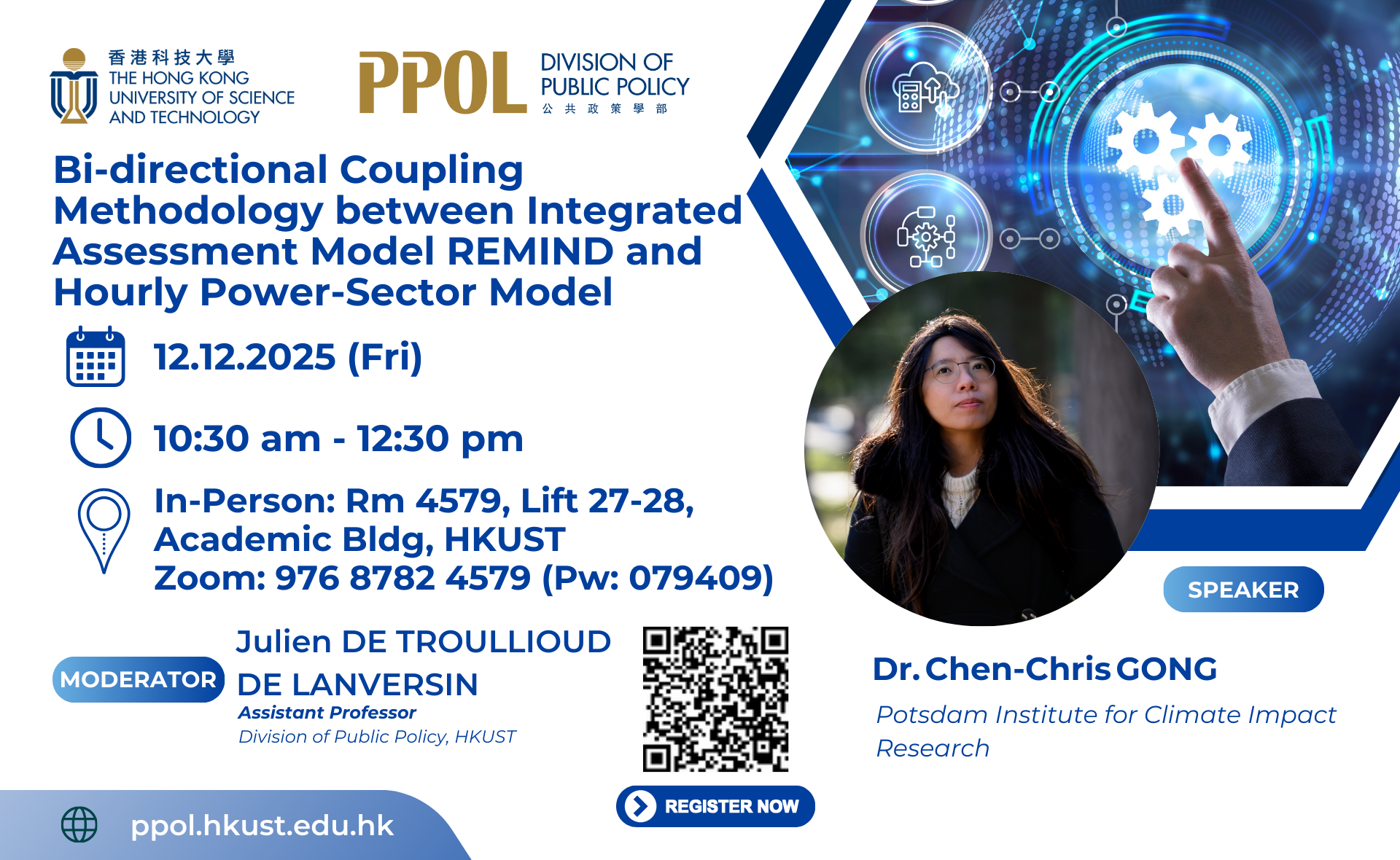
Abstract:
In this talk, Dr. Gong will showcase the latest frontier in high-resolution integrated assessment: a soft-coupling between the sectoral energy model IAM REMIND and the fine-grained, hourly energy-system model PyPSA and DIETER.
· Why this matters:
o IAMs excel at long-term, multi-regional analysis for climate mitigation scenarios but typically operate at coarse temporal resolution (annual or “typical-day” hourly).
o ESMs such as PyPSA and DIETER deliver hour-by-hour detail (8760 hours/year) across hundreds of nodes, enabling precise dispatch and trade-flow analyses.
By linking the two, the combined framework retains the strategic, cross-sectoral insight of IAMs, e.g., endogenous electricity-demand projections driven by sectoral technology pathways, while also incorporating the operational constraints inside ESMs. Using a method developed in a first-of-a-kind bidirectional soft-coupling study for Germany, we have conducted further scenario studies for Germany/Europe, and China, revealing granular dispatch margins, inter-provincial trade flows, and optimized generation mixes that align with overall emission targets.
This bi-directional coupling thus represents a state-of-the-art tool for researchers and policymakers seeking both strategic foresight and operational precision in energy-transition planning. Both models are open-sourced, and presents a community-approach to study energy transition, allowing diverse stakeholders an opportunity to visualize and understand the complex dynamics arising from renewable based energy transitions.
Biography:
Dr. Chen-Chris Gong is a member of the Energy System Lab, the Global Energy Transition Team and the International Climate Policy Team of the Potsdam Institute for Climate Impact Research. Her work centers on energy-transition pathways for China, India, and the globe, with three main pillars:
Power sector modeling in long-term climate mitigation frameworks – she iteratively couples the integrated assessment model REMIND with the hourly power-sector model DIETER (DIW).
National transition pathways – she develops detailed roadmaps for China and India.
Global low-overshoot scenarios – she explores pathways that keep end-of-century cumulative CO₂ emissions below the 1.5 °C budget with low overshoot/peak temperature.
Beyond these core areas, Dr. Gong contributes to:
· Coupling REMIND with PyPSA-China-PIK (an extension of PyPSA-China-TU Berlin).
· Decarbonizing the steel sector.
· Analyzing the political economy of the green transition.
· Providing critical reviews of integrated assessment modeling practices.

In this talk, Dr. Gong will showcase the latest frontier in high-resolution integrated assessment: a soft-coupling between the sectoral energy model IAM REMIND and the fine-grained, hourly energy-system model PyPSA and DIETER.
· Why this matters:
o IAMs excel at long-term, multi-regional analysis for climate mitigation scenarios but typically operate at coarse temporal resolution (annual or “typical-day” hourly).
o ESMs such as PyPSA and DIETER deliver hour-by-hour detail (8760 hours/year) across hundreds of nodes, enabling precise dispatch and trade-flow analyses.
By linking the two, the combined framework retains the strategic, cross-sectoral insight of IAMs, e.g., endogenous electricity-demand projections driven by sectoral technology pathways, while also incorporating the operational constraints inside ESMs. Using a method developed in a first-of-a-kind bidirectional soft-coupling study for Germany, we have conducted further scenario studies for Germany/Europe, and China, revealing granular dispatch margins, inter-provincial trade flows, and optimized generation mixes that align with overall emission targets.
This bi-directional coupling thus represents a state-of-the-art tool for researchers and policymakers seeking both strategic foresight and operational precision in energy-transition planning. Both models are open-sourced, and presents a community-approach to study energy transition, allowing diverse stakeholders an opportunity to visualize and understand the complex dynamics arising from renewable based energy transitions.