Sections
Text Area

Events

Right Column
Text Area

Events & Seminars

Dec

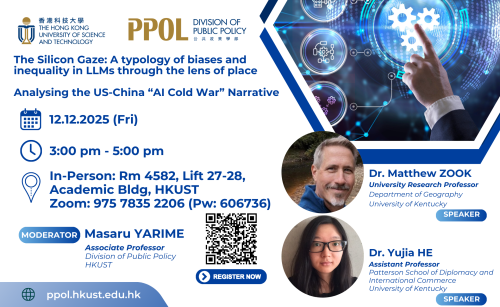
12

3:00 pm - 5:00 pm
Rm 4582, Lift 27-28, Academic Bldg, HKUST
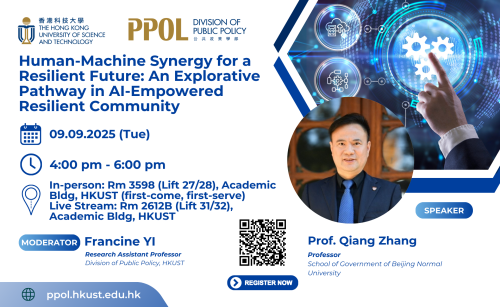
The Silicon Gaze: A typology of biases and inequality in LLMs through the lens of place & Analysing the US-China “AI Cold War” Narrative

The Silicon Gaze: A typology of biases and inequality in LLMs through the lens of place
This paper introduces the concept of the silicon gaze to explain how large language models (LLMs) reproduce and amplify long-standing spatial inequalities. Drawing on a 20.3-million-query audit of ChatGPT, we map systematic biases in the model's representations of countries, states, cities and neighbourhoods. From these empirics, we argue that bias is not a correctable anomaly but an intrinsic feature of generative AI, rooted in historically uneven data ecologies and design choices. Building on a power-aware, relational approach, we develop a five-part typology of bias (availability, pattern, averaging, trope and proxy) that accounts for the complex ways in which LLMs privilege certain places while rendering others invisible.
Analysing the US-China "AI Cold War" Narrative
Discussions about artificial intelligence (AI) are gaining prominence in the recent revival of “cold war” narratives comparing US-China relations today to the historical rivalry between the US and the Soviet Union. Drawing on a review of existing academic and policy literature engaging with the “AI cold war” narrative, this paper examines how the narrative is justified, and numerous ways that it can be challenged. It finds that the framing is largely driven by the securitisation of AI, as state actors and policy pundits view AI innovations' dual-use capabilities as key to national security and ideological competition. However, critics posit that the narrative exaggerates China's AI capabilities, promotes commercial interests of tech firms and defence contractors, creates self-reinforced militarisation, and undermines the potential for international research and regulatory cooperation. Moreover, the Cold War binary framing may misrepresent the global distribution of AI capabilities. To extend beyond the AI cold war narrative, future research may recognise the limitations of the binary framing and expand analysis on the AI development strategies of third-party players (including those from the Global South) drawing upon local and regional political economic dynamics and development contexts. This paper concludes by inviting scholars to rethink the affective power of narratives and contribute research and narrative analysis that allow for the articulation of perspectives from third countries.

Aug

21

9:00 am - 10:00 am
Room 4472 (Lifts 25-26), 4/F Academic Building, HKUST
PHD THESIS PRESENTATION
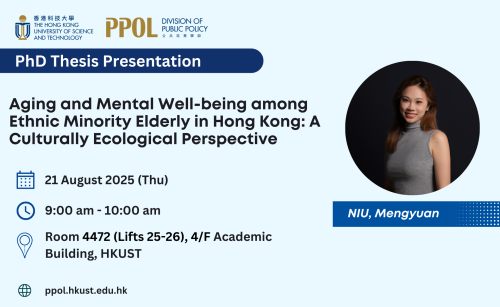
Aging and Mental Well-being among Ethnic Minority Elderly in Hong Kong: A Culturally Ecological Perspective

The growing aging population has drawn increasing attention to aging arrangements and mental health issues among older adults. However, despite the rapid growth of ethnic minority (EM) older populations alongside overall demographic aging, their distinct needs remain largely neglected in policy planning and service provision. While extending literature has focused on discrimination, poverty, and ethnic inequality, this study adopts a more comprehensive, culturally informed perspective to examine EM aging and mental health challenges, and to propose policy-level strategies to address these issues.

To have a comprehensive view of EM aging and mental health challenges, this thesis builds on an ecological framework to enable a multi-level analysis, spanning individual, interpersonal, community, and policy dimensions. Through interviewing EM older adults in Hong Kong, the first study investigates the factors influencing their preferences for aging-in-place arrangements. The second study takes a global perspective, identifying the culturally shaped coping strategies they employed in response to mental health challenges. Recognizing the importance of traditional family values among ethnic minorities, the third study using self-collected survey data examines the mechanisms linking public transfers, private financial support, and the mental well-being of EM older adults.

Collectively, the findings highlight the critical importance of cultural inclusiveness in aging policy making. This thesis contributes not only empirical evidence on aging and mental well-being among ethnic minorities, but also emphasizes the crucial role of cultural context in shaping EM mental health, influencing decisions related to aging arrangements, and determining the effectiveness of social protection policies.

May

26

9:30 am - 10:30 am
Room 5583 (Lifts 29-30), 5/F Academic Building, HKUST
PHD THESIS PRESENTATION
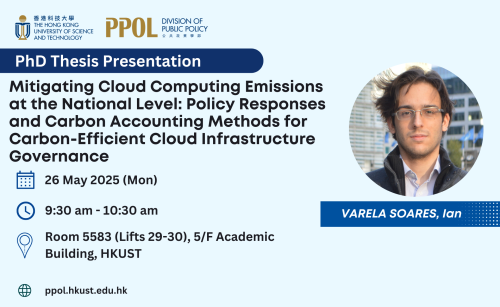
Mitigating Cloud Computing Emissions at the National Level: Policy Responses and Carbon Accounting Methods for Carbon-Efficient Cloud Infrastructure Governance

The expansion of data centers and telecommunication networks has raised environmental concerns driven by surging electricity consumption and corresponding greenhouse gas (GHG) emissions. While the environmental impacts of ICT infrastructure are acknowledged, monitoring emissions and policy design remain underdeveloped. This dissertation examines public policy challenges in cloud emission estimation addressing three parameters: (1) existing policy measures to mitigate data center impacts, (2) a novel carbon accounting framework for cloud emissions (consumption-based), and (3) implementation pathways for this framework.
Parameter (1) is assessed via qualitative content analysis of six data center hubs: Singapore, the Netherlands, Ireland, Germany, the USA, and the UK. The study categorizes policy responses as disruptive (halting new licenses), adjustment (implementing stricter standards), or continuation (maintaining deployment despite environmental impacts). The analysis indicates that stricter energy accuracy standards support growth planning, while policies align infrastructure strategies with available electricity capacity.
For parameter (2), the research examines the limitations of the traditional, location-based carbon allocation method. The method overlooks the geographical separation between emission sources and cloud consumers. Using the consumption approach for three of the six hubs (Germany, Ireland, and the Netherlands) from 2017 to 2022 reveals differences in consumption profiles: Germany’s cloud emissions are 75% domestic, Ireland’s 85% foreign, and the Netherlands’ split evenly, highlighting the need for equitable emission accountability.

To address parameter (3), the study identifies four estimation risk sources: emission factors, methods, data sources, and boundary definitions. These risk sources stem from the location-based method that overlooks the geographical separation between cloud hosts and consumers, which risks disproportionately allocating emissions only to cloud-hosting jurisdictions. The study proposes three policy interventions to mitigate the risks: stricter accounting rules, eco-labeling, and carbon border adjustments. The findings of the three dimensions are summarized into a decision framework to guide governments in monitoring and mitigating cloud emissions.