

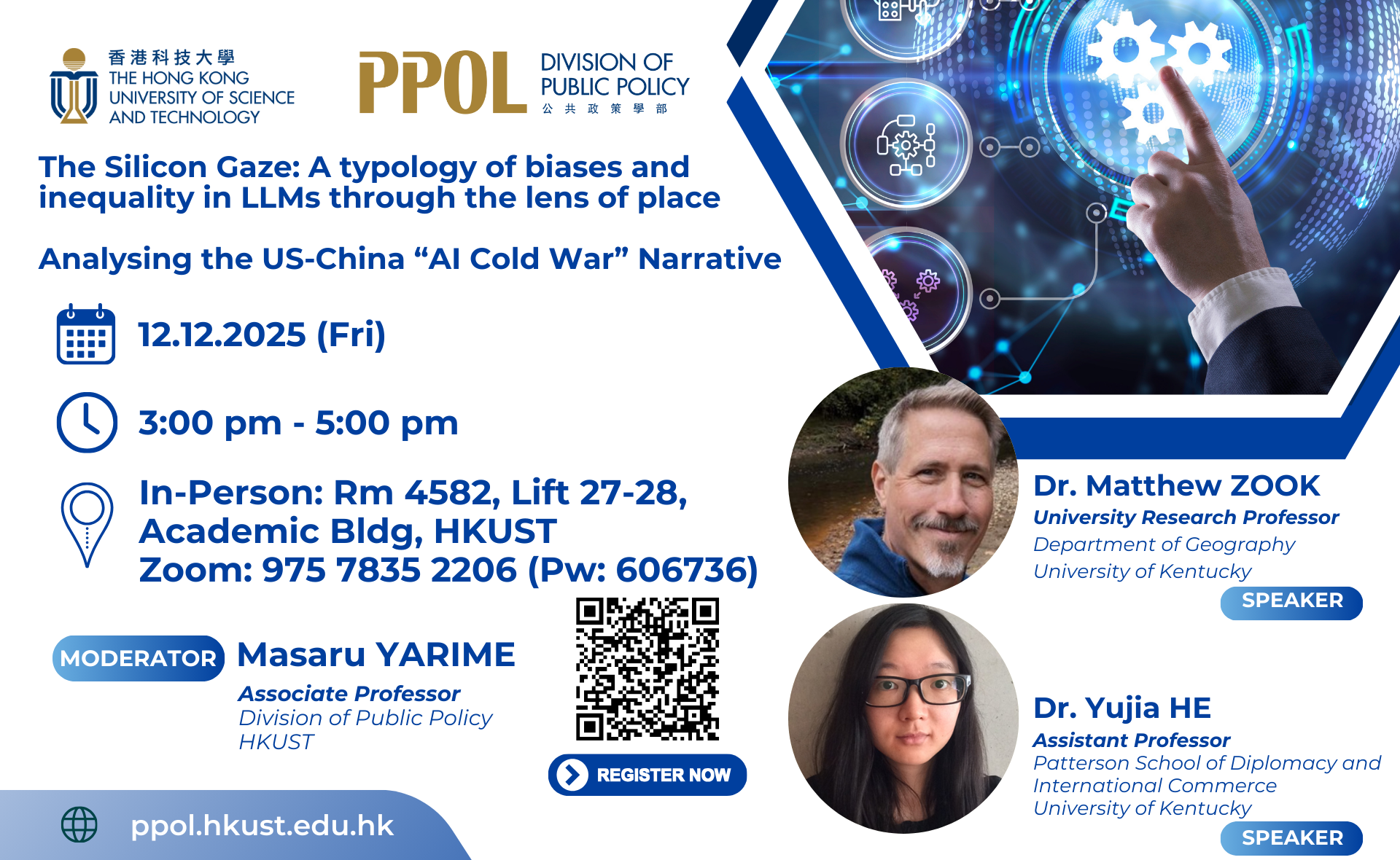
Dr. Matthew Zook is a University Research Professor in the Department of Geography, University of Kentucky. His research interests cover digital and economic geographies, critical financial studies, and urban geography. He is the managing editor for Big Data & Society, an open-access peer-reviewed journal that publishes interdisciplinary work principally in the social sciences, humanities, and computing and their intersections with the arts and natural sciences about the implications of Big Data for societies. The Journal's key purpose is to provide a space for connecting debates about the emerging field of Big Data practices and how they are reconfiguring academic, social, industry, business and government relations, expertise, methods, concepts and knowledge.

Dr. Yujia He is an assistant professor at the Patterson School of Diplomacy and International Commerce, University of Kentucky. Her research interests span science and technology policy, international political economy, development studies, and Asian studies. Her current and past projects study Chinese tech firms' overseas expansion, smart city development and international partnerships, digital trade and data governance, AI's impact on labor, the political economy of emerging technologies, public participation in science, rising powers in global economic governance, and rare earths trade and governance. Her research has appeared in leading journals such as International Affairs, Information Society, Information Communication & Society, Journal of Urban Affairs, Third World Quarterly, Georgetown Journal of Asian Affairs, Financial Innovation, Finance and Space, Resources Policy, Politics and Governance, Asia Policy, and numerous think tank reports. She is strongly interested in international collaborative research, with experience in fieldwork and research collaboration with scholars in over ten countries and regions, supported by multiple research grants. She has held fellowships or research positions with Hong Kong University of Science and Technology Institute for Emerging Market Studies and Jockey Club Institute for Advanced Study, United Nations University Institute in Macau, Wilson Center's Science and Technology Innovation Program, University of Chicago Center in Beijing, George Washington University Center for International Business Education and Research, Atlantic Council Scowcroft Center for Strategy and Security. She is an executive team member and communications officer of the Science Tech and Arts in International Relations (STAIR) section of the International Studies Association.
This seminar is supported, in part, by the UKinSPIRE (Seeding Partnerships for International Research Engagement) grant awarded to Dr. Yujia He and Dr. Matthew Zook by the University of Kentucky International Center and Office of the Vice President for Research. Dr. Masaru Yarime (HKUST) is the international partner for this research collaboration.

The Silicon Gaze: A typology of biases and inequality in LLMs through the lens of place
This paper introduces the concept of the silicon gaze to explain how large language models (LLMs) reproduce and amplify long-standing spatial inequalities. Drawing on a 20.3-million-query audit of ChatGPT, we map systematic biases in the model's representations of countries, states, cities and neighbourhoods. From these empirics, we argue that bias is not a correctable anomaly but an intrinsic feature of generative AI, rooted in historically uneven data ecologies and design choices. Building on a power-aware, relational approach, we develop a five-part typology of bias (availability, pattern, averaging, trope and proxy) that accounts for the complex ways in which LLMs privilege certain places while rendering others invisible.
Analysing the US-China "AI Cold War" Narrative
Discussions about artificial intelligence (AI) are gaining prominence in the recent revival of “cold war” narratives comparing US-China relations today to the historical rivalry between the US and the Soviet Union. Drawing on a review of existing academic and policy literature engaging with the “AI cold war” narrative, this paper examines how the narrative is justified, and numerous ways that it can be challenged. It finds that the framing is largely driven by the securitisation of AI, as state actors and policy pundits view AI innovations' dual-use capabilities as key to national security and ideological competition. However, critics posit that the narrative exaggerates China's AI capabilities, promotes commercial interests of tech firms and defence contractors, creates self-reinforced militarisation, and undermines the potential for international research and regulatory cooperation. Moreover, the Cold War binary framing may misrepresent the global distribution of AI capabilities. To extend beyond the AI cold war narrative, future research may recognise the limitations of the binary framing and expand analysis on the AI development strategies of third-party players (including those from the Global South) drawing upon local and regional political economic dynamics and development contexts. This paper concludes by inviting scholars to rethink the affective power of narratives and contribute research and narrative analysis that allow for the articulation of perspectives from third countries.