

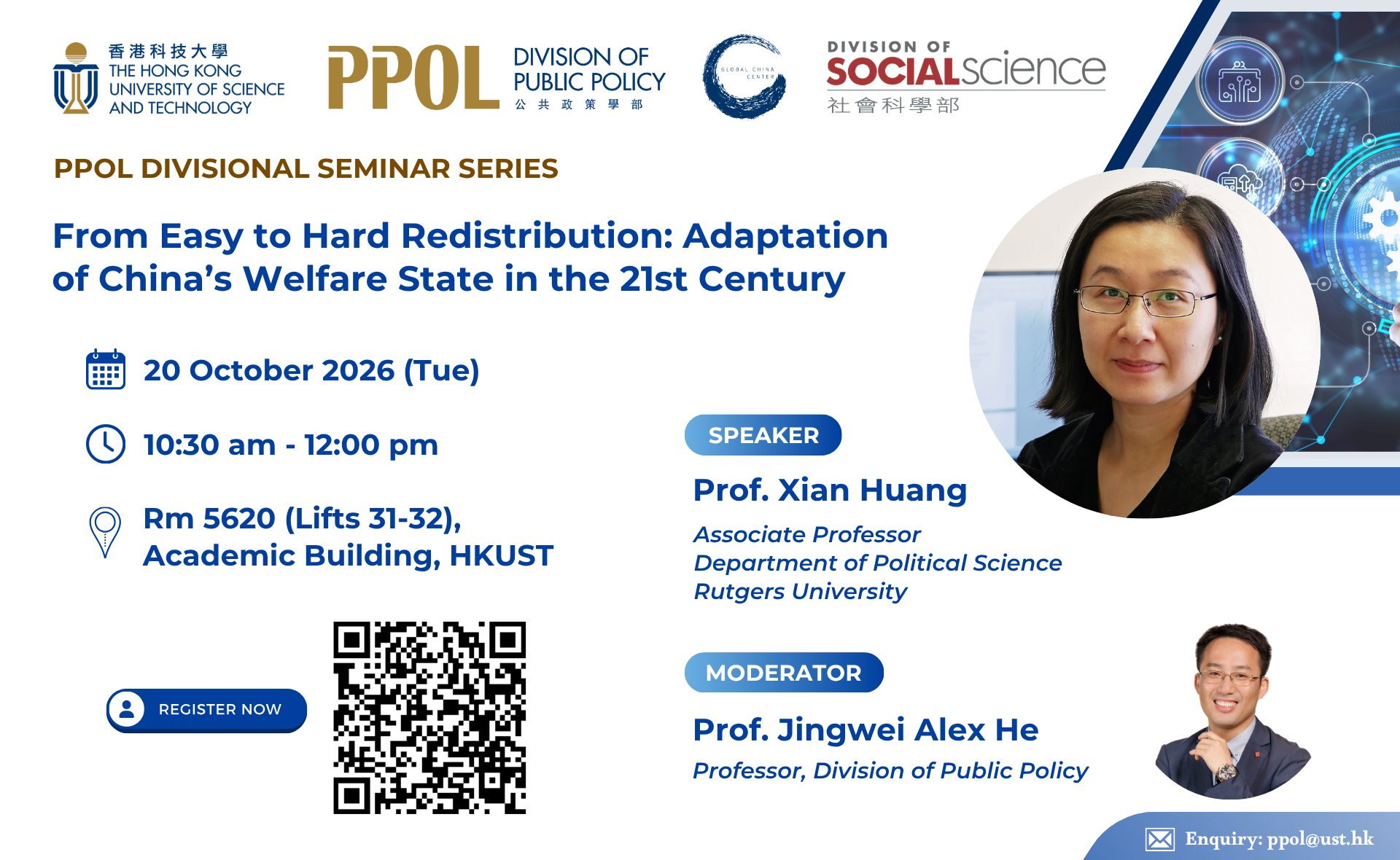
Abstract:
Existing research explains why non-electoral regimes expand welfare provision, yet pays less attention to how the welfare systems adapt when expansion becomes difficult due to structural constraints. This paper argues that China’s welfare state has transitioned from “easy” to “hard” redistribution—a reconfiguration of welfare provision characterized by a decline in group-targeted expansion, a rise of selective cross-group integration, and a persistent dominance of vertical fiscal allocation across regions. Drawing on a corpus of 33,205 policy documents, we employ quantitative text analysis to trace patterns in Chinese welfare policy from 2000 to 2024. We find that since 2014, the government has increasingly emphasized integrating welfare programs across selected groups to facilitate risk pooling and cost sharing, while continuing to prioritize vertical allocation of responsibilities and resources between upper- and lower-level governments over horizontal coordination. These findings demonstrate the adaptation of China’s welfare state on both social and territorial dimensions under tightening fiscal and demographic constraints.
Department of Political Science
Rutgers University
Xian Huang is an Associate Professor in the Department of Political Science at Rutgers University and is affiliated with the Rutgers Center for Chinese Studies. Her research interests include (1) political causes and consequences of social inequality, stratification, and (im)mobility; (2) redistribution, social welfare, and health policies; (3) public opinion and preferences under authoritarian rule. The regional focus of her research is China and East Asia. Xian received a PhD of Political Science from Columbia University. Before joining Rutgers, she was a postdoctoral fellow in the Center for the Study of Contemporary China at University of Pennsylvania.

Join us for the Divisional Seminar, with Prof. Xian Huang as our distinguished speaker. This paper argues that China’s welfare state has transitioned from “easy” to “hard” redistribution. Drawing on a corpus of 33,205 policy documents and employing quantitative text analysis to trace patterns in Chinese welfare policy from 2000 to 2024, the study finds that since 2014, the government has increasingly emphasized integrating welfare programs across selected groups while continuing to prioritize vertical allocation of responsibilities and resources between upper- and lower-level governments. Click here for more information and to register!